Published: 04/07/2026
By Jamie Hansen, Global Health Communications Manager
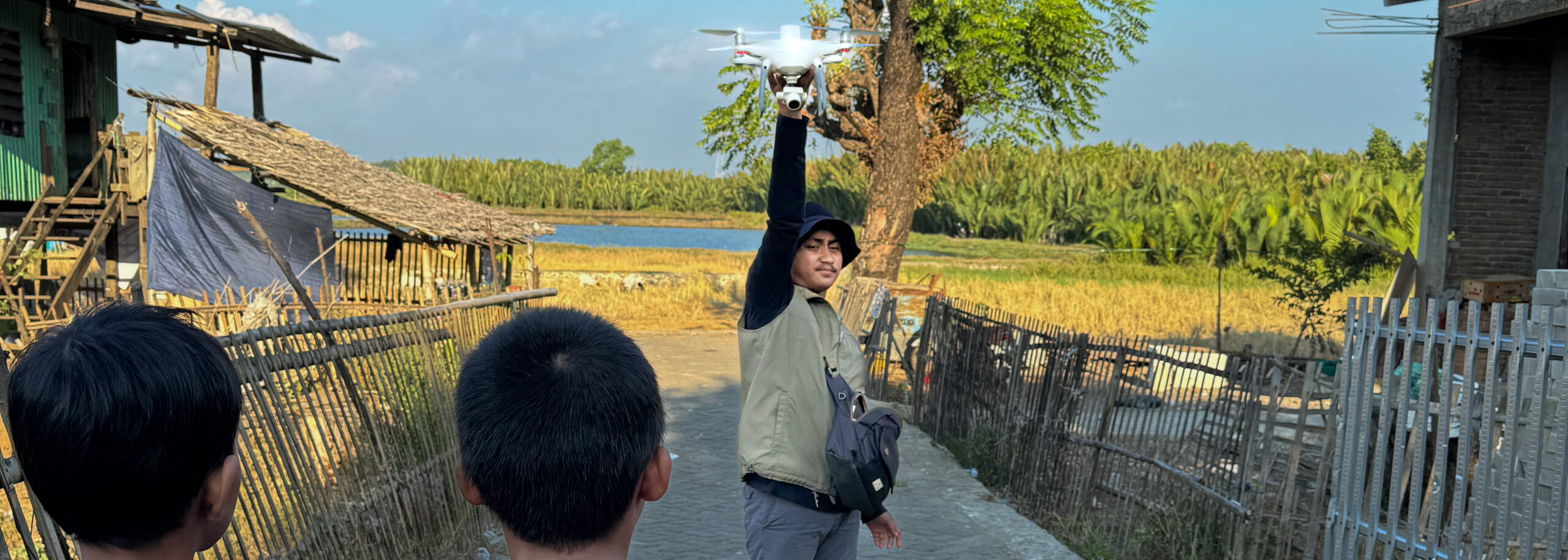
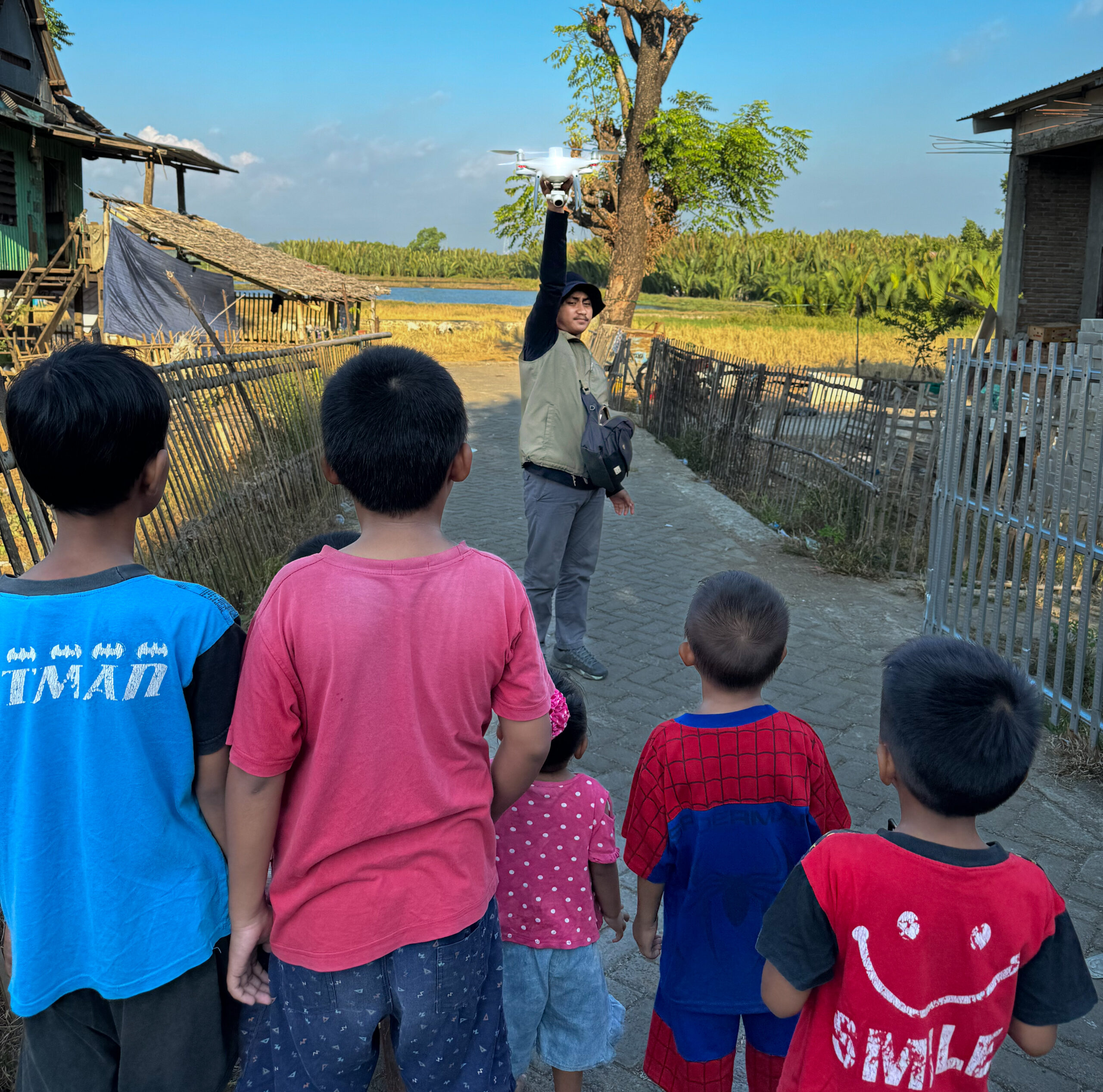
Cover photo: A local drone pilot (Muh. Yusuf Fadhel Marwiji) in Makassar, Indonesia prepares to launch a drone to search for tires as curious children watch. Photo by Morgan Tarpenning.
Anyone who has left water standing in a wading pool or empty flower pot knows how quickly mosquitoes arrive. But these backyard nuisances can spawn serious diseases: dengue, chikungunya, and Zika are all transmitted by mosquitoes breeding in water that collects in shallow containers.
As warming temperatures push dengue-carrying mosquitoes farther north into places like the southern United States and Europe, eliminating breeding sites is more critical than ever. Yet the task is painstaking and imperfect: potential breeding sites such as old tires tucked against fences or buried under vines are easy to miss during ground surveys.
Now, Stanford researchers are demonstrating how a powerful combination of drones and artificial intelligence can track down these hidden threats faster and more accurately than ever before. This, in turn, can transform how communities fight the growing threat of mosquito-borne disease.
“We are at a turning point,” said Joelle Rosser, assistant professor of medicine-infectious diseases at Stanford Medicine and a leading researcher in drone-based disease surveillance. “Recent technological advances in high-resolution remote sensing and artificial intelligence have allowed us to completely reimagine how we study interactions between the environment and humans and how we respond to a rapidly changing environment.”
Finding the needles in the haystack
The team tested their approach in Makassar, Indonesia—a dengue hotspot—but the method could be deployed anywhere mosquito-borne diseases threaten communities, including in the United States.
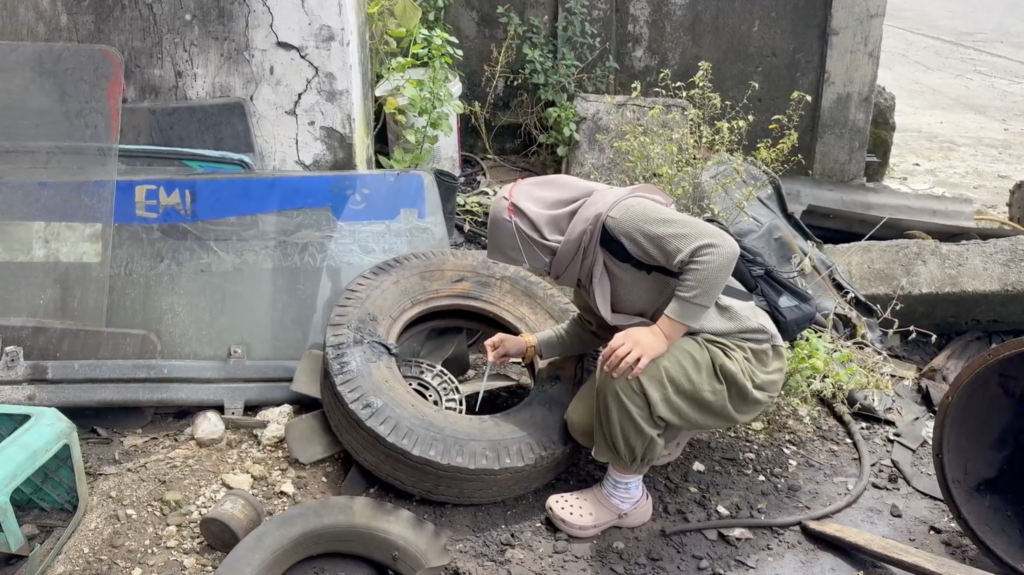
In the densely packed coastal city of Makassar, Indonesia, thousands of discarded tires lie scattered across rooftops, hidden behind fences, and cloaked by vegetation. Easily overlooked, these tires collect rainwater to form an ideal breeding ground for Aedes aegypti mosquitoes that transmit dengue and other diseases to hundreds of millions of people worldwide.
Tracking and eliminating these hidden habitats across such a large urban landscape has been nearly impossible—until now.
Working with collaborators in Indonesia, researchers used drone imagery combined with deep learning algorithms to automatically detect discarded tires across a 4-kilometer section of the city. They chose the study area for its dense population and diverse land uses, from informal settlements to neighborhoods and markets.
“Discarded tires are among the most problematic mosquito breeding sites because they hold water, provide shade, and are often undisturbed—ideal for Aedes aegypti larvae,” explained Andrew Chamberlin, a research scientist based at Stanford’s Doerr School of Sustainability specializing in drone and satellite-based computer vision for disease ecology and co-first author of the study. “The challenge is that many are essentially invisible to ground surveys: on rooftops, behind fences, or tucked into vegetation across enormous areas that teams can inspect only a tiny fraction of. Drones allow us to survey entire districts and show health workers exactly where the problems are.”
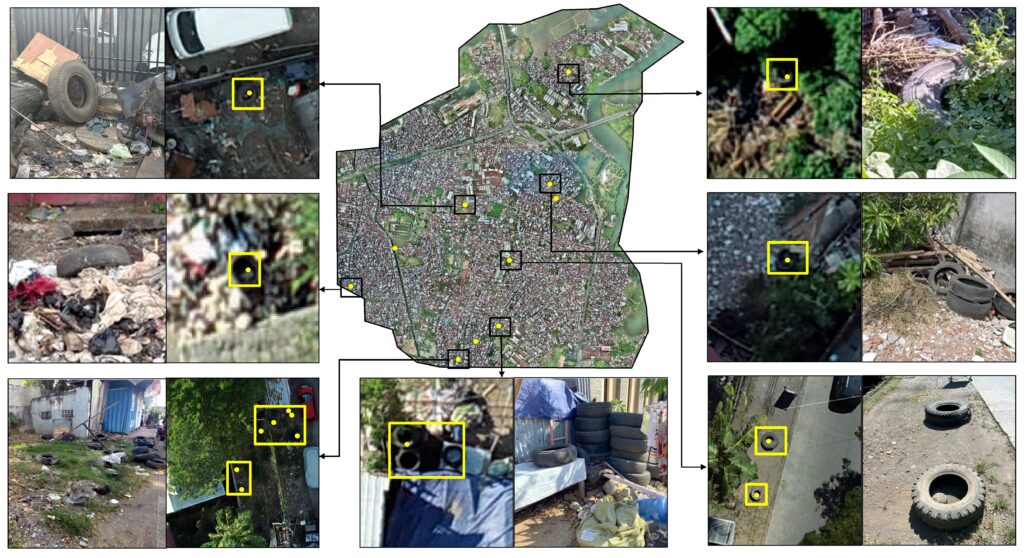
The researchers worked with local drone pilots to capture high-resolution images. They then trained two AI systems to identify the locations, shapes, and distribution of discarded tires. Both models (advanced convolutional neural networks) demonstrated remarkably high accuracy, with one model, U-Net++, discovering nearly twice as many actual tires as human analysts reviewing the same imagery. The AI systems even successfully identified tires partially submerged in water or hidden under plants and shadows. Read the publication here.
A key benefit of drones is their ability to access physically remote and underserved communities, noted Mehedy Hassan, a postdoctoral researcher in the Stanford Department of Medicine-Infectious Diseases and the study’s other first author. “This capability reduces operational costs while significantly expanding surveillance coverage,” Hassan said. When combined with AI-driven detection, he added, drones enable “rapid identification of high-risk areas, supporting faster, more accurate, and highly targeted intervention strategies.”
A timely solution to an urgent problem
The timing couldn’t be more critical, Rosser emphasized. As climate change drives warming temperatures and more frequent flooding, mosquito populations are surging. With limited vaccines available and no targeted treatments for dengue and related viruses, eliminating mosquito breeding sites is one of the most effective disease prevention strategies.
“This method’s ability to accurately and rapidly detect high-risk Aedes aegypti breeding sites is a promising new tool to improve vector control at a time when disease threat is growing due to changes in temperature, rainfall, and land use,” Rosser said.
The researchers emphasized the need for further research in this growing field. Rosser and collaborators plan to test how their surveillance methodology, which goes beyond tires to classify many types of trash, can transfer to other parts of the world. They also hope to explore the use of “multispectral imagery” to improve breeding site predictions. This could help vector control programs prioritize the riskiest types of trash for removal.
“The mosquitoes that transmit dengue, chikungunya, and Zika viruses are already in the U.S. and every year we see more people infected with these viruses locally,” Rosser said. “Our goal is to develop a tool that could be adapted to any geographical context and easily incorporated into existing mosquito surveillance and control programs.”
Drones: A powerful tool for keeping pace with shifting health risks
The potential uses for drones and AI to address growing health risks from environmental stressors extend far beyond mosquito control. In another new paper in BMC Global and Public Health, Rosser and colleagues outline how drones offer unique advantages for research at the intersection of health and the environment.
Drones can be deployed quickly and operated remotely while providing visual access to hard-to-reach or hazardous areas. For instance, responders can send drones remotely into areas devastated by hurricanes to assess damage and injuries quickly. Organizations are also using drones to deliver emergency medical supplies to remote or disaster-affected areas.
Drones are also adaptable and cost-effective compared to traditional aircraft or satellite imaging. Among other things, they can help farmers manage their plants during extreme weather by monitoring for drought and heat stress.
“As environmental stressors escalate worldwide, we believe drones will play an increasingly vital role in monitoring and mitigating climate change’s impacts on human health—helping public health officials stay one step ahead of rapidly evolving threats,” Rosser said.
Acknowledgements
Authors of the review publication include: Juliet T. Bramante, Morgan S. Tarpenning, Katherine E. Woo, Andrew J. Chamberlin, Kavita D. Coombe & Joelle I. Rosser. This work was supported by the National Institutes of Health K32 AI168581 (JIR) and the American Society of Tropical Medicine and Hygiene–Burroughs Wellcome Fund (JIR).
Authors of the Deep learning for Aedes aegypti breeding site detection publication include: Mohammad Mehedy Hassan, Andrew J. Chamberlin, Morgan S. Tarpenning, Whitney C. Weber, Kavita Dave Coombe, Giulio A. De Leo, Muhammad Junaid, Andang Suryana Soma, Ansariadi, and Joelle I. Rosser. This research was supported by the ASTMH-Burroughs Wellcome 652 Trust (JIR), NIH K32 AI168581 (JIR), and Stanford Woods Institute for the Environment 653, and the Stanford Center for Human and Planetary Health.
Anthropic’s Claude 4-5-Sonnet was used for editing this article for brevity and to reduce grammatical, spelling, or other typographical errors.
—————-